
Today on the Digital Age series on The Gottman Relationship Blog, we are excited to feature a guest posting from Gottman Bringing Baby Home (BBH) Educator Kim Brickwood. A native of Australia, Kim is the Director of Path 2 Parenting, a professional organization that provides early parenting educators with the skills necessary to facilitate education groups for couples undergoing the transition to parenthood. She is one of four Gottman BBH Training Specialists in Australia certified to train educators in the Gottman BBH program.
Bringing Baby Home in The Digital Age
By Kim Brickwood
Are you spending more time with your smartphone or tablet than you are with your child?
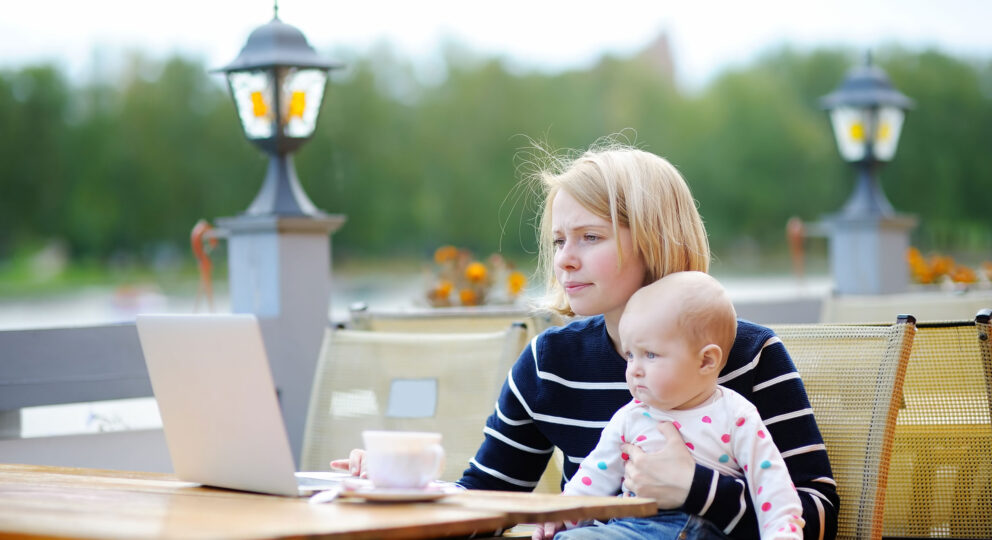
It is a sunny morning when my family and I stop at the local café for morning tea. The café, which houses a gift shop, is full and bustling with patrons and staff. I glance over to the table next to me and notice a young mother and her baby who looks to be about five months old. It is a small square table and mum is seated on one side, her baby is in the pram to her left. The little girl is hungrily devouring the bottle that her mother holds in her mouth. So, I hear you say, what is so compelling about this? As I watch, the little girl with wide, bright eyes drinks and gazes lovingly at her mother. Mum meanwhile is busily texting on her mobile phone, looking down at the table, holding the bottle with her left hand and texting with her right. There is no eye contact, no visible sign of connection, and no communication with the infant.
This scenario is not restricted to mothers and babies; it can be witnessed multiple times a day in shops, parks, homes, and cinemas between couples, friends, and work colleagues and even between a customer and retailer.
Isn’t it ironic that the modern technology which allows us to instantly connect with people in other cities and/or countries provides a barrier to connecting with the person sitting at the same table?
Communication is the cornerstone of all relationships. The birth of a baby takes a couple on a roller coaster ride of emotions. It is a time of mixed feelings, a canvas decorated with happiness, excitement, and wonder tinged with anxiety, uncertainly, doubt, and coloured with sleep deprivation. Under these circumstances it is normal for conflict to rise. It is important for the couple to take the time to connect, to get away from the computer, the mobile phone, the television and really talk to and appreciate each other and cultivate their relationship.
Wise parents understand that babies do not react like computers or telephones. They do not provide the instant responses we have become accustomed to. A wise parent will slow down and patiently wait for their baby to process the information before they respond and this can take several minutes. They make sure baby is wide awake and relaxed with alert eyes before trying to connect. The wise parent communicates through mutual eye contact, using big facial expressions and the higher pitched speech known as mother-ease to connect with baby.
Research tells us that in moments of mutual gaze and communication between an infant and their caregiver neuronal pathways are developed adding to the all important architecture of the infant’s brain. Babies learn to communicate from their caregivers. They learn how to be social, how to take turns, and how to act and react with others in a meaningful way. Our faces are a live canvas with expressions constantly changing. We are the most interesting toy for our babies.
_________________________________________
Click here to learn more about the Gottman Bringing Baby Home Program, which combines scientific research and public education to improve the quality of life for babies and children. Our goal is to promote social change by making the BBH workshop available as part of the standard birth preparation program offered to expectant couples in hospitals throughout the world.