

0

Accepting Influence: Find Ways to Say “Yes”

What does "accepting influence" mean?

Couple on a computer

In theory, most people agree that it’s a good idea for both partners in a relationship to have influence in decision-making. You imagine you’re good at working as a team, compromising, and going back and forth—if only your partner would be more flexible. 

Research conducted by Drs. Gottman and Jacobson showed that men who accept influence from their female partners tend to have happier and more satisfying relationships. Paradoxically, what the research also showed was that the more influence a partner was willing to accept, the more influential that partner was in the relationship overall.

In reality, accepting influence is an equal opportunity concept. All intimate relationships work better when both partners have and accept influence. In fact, this is one of the hallmarks of a successful relationship, one in which there is a pattern of respectful influence going back and forth and both partners feel that things are fair. 

What does it mean to accept influence?

In discussing this idea in couples therapy, there’s sometimes a belief that you have to comply or just go along with your partner to truly accept influence. “If I just say ‘Yes, dear,’ everything’s okay,” a client said to me recently. This is a mistaken belief, as accepting influence is simply being open to the ideas and opinions of your partner, not agreeing or complying or giving in. By accepting influence, you acknowledge that your partner has a valid point of view. You welcome it, are willing to be influenced, and maybe have your perspective changed by it. Accepting influence says, “You are important, and your opinions matter to me even if (and bonus points for this, especially if) I  don’t agree with you.”  

Problems with resisting influence show up in many ways.  Some are clearly about one partner rejecting the other or needing to always have their own way. Others are more subtle, such as one partner appearing to seek input on something when behind the scenes they have made their decision already. Some people reflexively say or indicate “no” as a way to maintain control over a conversation or decision even if they actually agree with their partner.  There can be understandable reasons for any of these stances, but it’s important to note that the only message that’s getting communicated to the partner is “No.”

 On the other end of the spectrum are people raised in families or by cultural or societal norms to believe that they do not deserve to have influence, so why bother speaking up?  They think, ‘It’s not going to get me anywhere.’ Both ends of this spectrum can create power struggling and resentment.

Do you and your partner accept each other’s influence? Take our Love Quiz.

How to accept influence

So, how can you avoid the tugs-of-war that happen around this issue of influence?

First, check yourself

Self-awareness is key. You’re likely not trying to shut your partner down but are inadvertently doing so. That can sound like, “I’m just expressing my opinion” when in reality they’re thinking ‘… and this is the only opinion that matters.’ Ask yourself, are you really staying open to the other perspective? 

Listen with curiosity to the other point of view

Check to see if you are understanding correctly. It is so much harder to do this when you disagree, but the solution you can ultimately come to is going to feel a lot better if both of you feel understood and respected.

Remember the research

The more influence you accept, the more influential you will be. 

Look for ways to say “yes.” 

There is a benefit to you in yielding a bit, not being defensive, and being open to seeing that your partner has a valid perspective—even if you don’t share it. Think of it as looking for ways to say “yes,” even if that is a simple acknowledgment, such as, “I see your point.”  For many, this can be a challenge, but you have to ask yourself: Do you want to be right or do you want to stay together?

Find out how well you accept influence 

How can you know you’re in a happy relationship that’s both good for your health and everyone around you? Can such a thing be measured? It can! Take this free couples quiz and find out how well you know your partner and whether you are developing a negative perspective.

For an in-depth analysis of your relationship health check out the Gottman Relationship Adviser, a virtual relationship evaluation and improvement tool for couples.

The Adviser provides you with a full snapshot of your relationship satisfaction, outlines your strengths and weaknesses, and supplies tailored recommendations for improvement. Start building a happier relationship today!
Get your Relationship Communication Score

Answer simple questions and learn more about key relationship communication indicators like Feeling Heard, Turning Towards and Stonewalling

Ask Gottman

Your email address will not be published. Required fields are marked *

Sinead Smyth, LMFT is a Certified Gottman Therapist and Level 3 Trainer in Gottman Method Couples Therapy. Her counseling practice, East Bay Relationship Center, has offices in Pleasanton and Alameda, CA, and works with couples, families, teens, and individuals. You can visit her website here.

Recommended products

Original price was: $250.00.Current price is: $189.00.

The Gottman Relationship Adviser is a complete approach to relationship wellness. Measure your relationship health with the research-based Gottman Assessment, analyze five key areas of your partnership to identify your strengths and weaknesses, then start a tailored, step-by-step digital program proven to heal and strengthen your connection—all on your schedule and from anywhere.

The Adviser uses the legendary scientific Gottman Method to help you understand what’s really going on in your relationship—and gives you exactly what you need to improve it.


Original price was: $119.00.Current price is: $79.00.

Research-based Foundations for a Lifetime of Love.  The Gottman Relationship Coach is an inspiring and educational multimedia experience designed to enhance the well-being of relationships. Participants will be guided through research-based tools and communication skills that can transform relationships—all based on the popular Gottman Method. The first program, “How to Make Your Relationship Work”, is now available and includes:

  • The Gottman Method and How to Make Your Relationship Work
  • How do we predict the future of a relationship?
  • How to build a Sound Relationship House
  • What to do when the destructive Four Horsemen enter your relationship

“Buy Now” will take you to GOTTMAN CONNECT to purchase and view this product.

$799.00

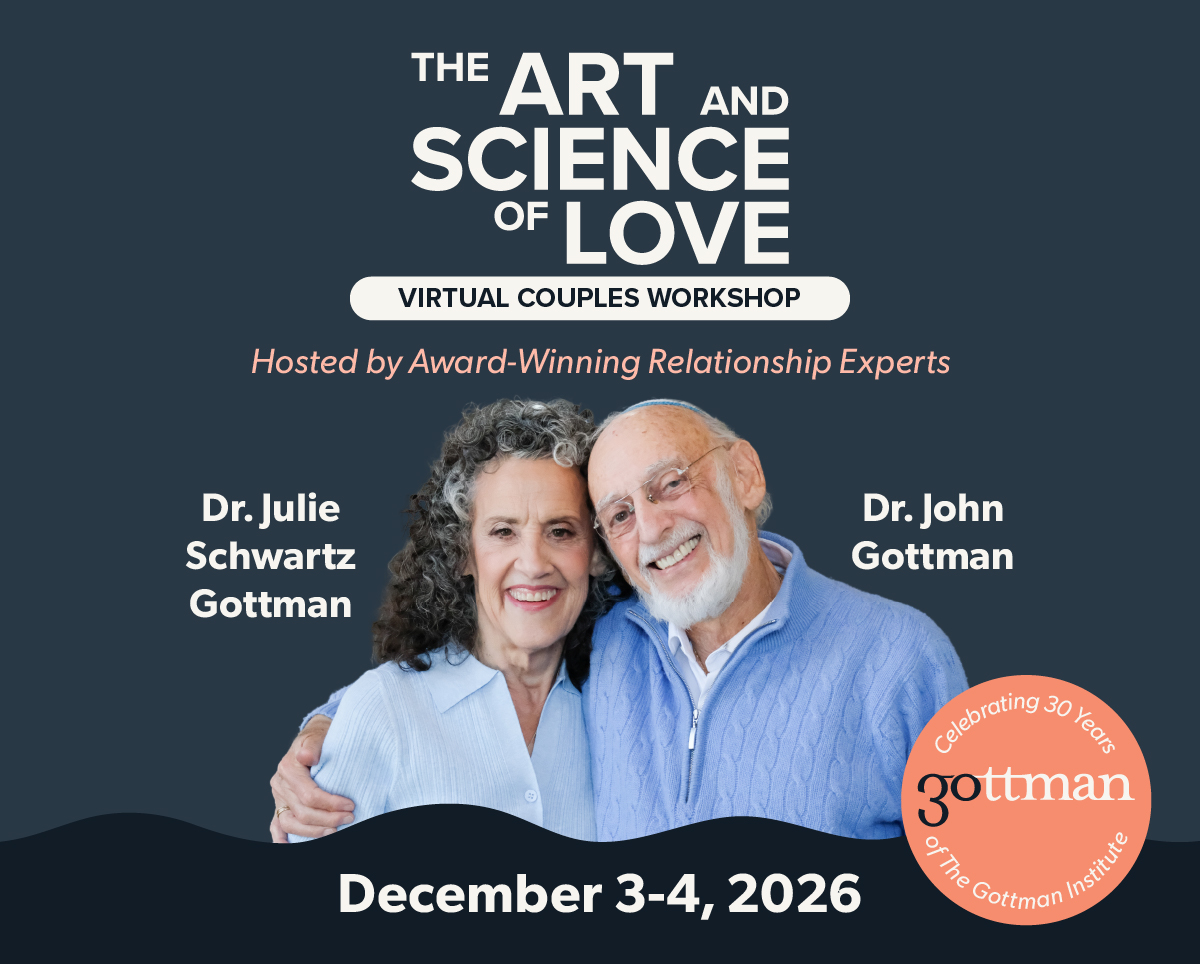
Created by “the Einstein of Love” (Psychology Today), this two-day workshop is grounded on what actually works in relationships that are happy and stable. See for yourself why millions of couples worldwide have benefited from the Gottman Method.

Quote from participant in most recent Live Virtual Workshop:

The Art and Science of Love workshop- where do I begin? It was an absolute stellar workshop. We were looking forward to this for weeks, and it exceeded our expectations! It was well-structured, and well-organized, and provided a wealth of information with real-time demonstrations of how to work through specific scenarios. The outstanding support that was provided throughout the exercises with therapists on standby- WOW! Priceless!

Includes the Art & Science of Love box set.  Please allow time for shipping.  Please Note: This is a live online event. To attend, you will need a reliable internet connection. Our staff will reach out to you with your personal registration and access information.

Related posts

One partner using AI to get relationship advice while her partner sits nearby.

When AI Makes Couples More Certain, But Not More Connected

Dana McNeil

AI can offer relationship advice, but can it build connection? Explore how relying on AI may reinforce assumptions rather than foster understanding between partners.

Read More

Emotional cheating: a woman alone at a coffee-shop table, hand against her cheek, behind a dark pillar

How a Coffee-Shop Friendship Can Turn Into Emotional Cheating

Alexander Elguren

He told himself it was innocent. He didn't tell his wife.

Read More

A woman with curly dark hair in a white shirt looks at the camera while a man in a dark shirt holds her from behind, his face turned toward her.

The Sex Stopped. Neither of Them Said Anything.

Alexander Elguren

Why revealing yourself matters more than revealing lingerie.

Read More

Four people at a dinner table by an open window at sunset, one couple looking at a book together while the other two sit apart

You Still Get Along. It Might Still Be Roommate Syndrome.

Alexander Elguren

What the Term Means, and Why Marriages Like These Can Have a Renaissance.

Read More

A couple at a dark table, each looking down at a phone, not at each other

Phubbing Is Rarely Malice. It Still Can Hurt.

Alexander Elguren

What the Word Means, and When It Becomes a Problem Between You.

Read More

A couple at a cafe window: she looks past the camera in sunglasses while he leans on the counter and looks toward her, the kind of moment a partner can read as emotionally unavailable.

When Your Partner Seems Emotionally Unavailable

Alexander Elguren

You are not imagining the distance. You may be misreading it.

Read More

Improve your Relationship Skills with our Free Newsletters
0