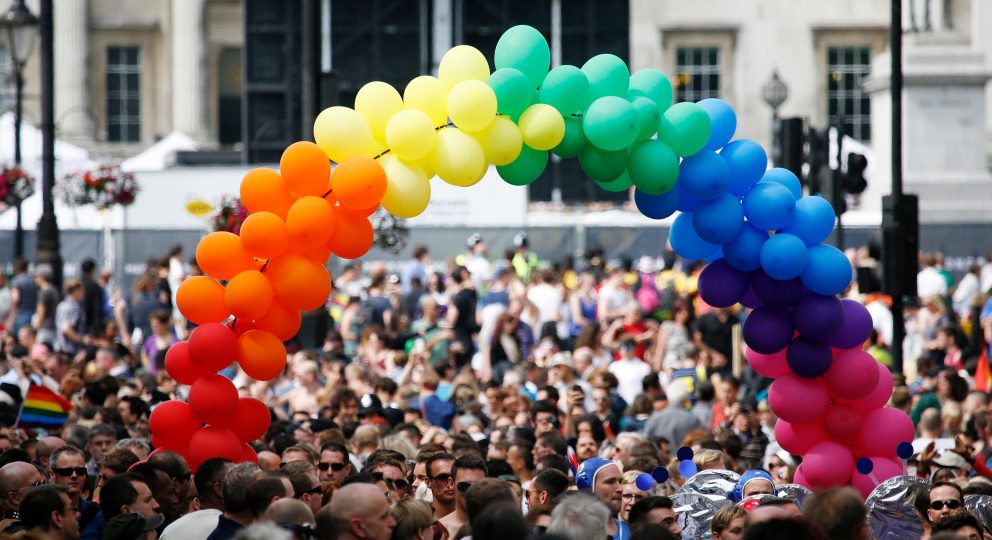
June marks the worldwide celebration of LGBTQ Pride. Cities across the world organize parades and demonstrations to raise the visibility of lesbian, gay, bisexual, transgender, and other members of the queer community. Pride can be a moving experience for any LGBTQ person, but for married same-sex couples, it can take on an added layer of meaning. Pride, properly understood, is an essential element to the success of our marriages in the face of external conflict.
To understand how Pride affects LGBTQ relationships, it’s important to first understand how it all started. This month’s celebrations commemorate the Stonewall Riots, which took place in New York City in June 1969. After years of harassment, shakedowns, and blackmail from corrupt police officers and the mafia, a group of patrons at the Stonewall Inn—a gay bar in Greenwich Village—resisted a police raid and demanded a stop to their mistreatment. The uprising was led by drag queens, trans women, and people of color. They were the marginalized within the marginalized—those whose lives society deemed the most shameful. They rose with a profound sense of dignity; with pride in knowing that they had no reason to feel shame.
Many misunderstand the reason for Pride Month. It’s a notion that is hard for the heterosexual and cisgender majorities to grasp because they think it’s about merely “flaunting” our sexual orientations or gender identities. The most tone-deaf among us mock the celebrations with talk of “heterosexual pride” parades. Those who are more charitable have trouble understanding because they see humility as a virtue and pride as its opposite vice—perhaps even as a sin. They’re all missing the point.
Pride for the LGBTQ community is not the opposite of humility. It is the opposite of shame. We’ve grown up in a world that tells us being gay, bisexual, or trans is shameful. Queer people grow up with the message that we must change our nature. When it becomes clear that we’re unable to do that, we’re told we should hide it. When we celebrate Pride, we celebrate the fact that who we are is not shameful.
Many LGBTQ people bring an enormous amount of shame into their relationships due to years of internalized messages about their worthlessness and brokenness. In marriage, shame becomes a latent virus that activates and sickens a relationship at a moment’s notice. Shame can keep couples from effectively navigating conflict because it leads them to believe that resolution is pointless, or that they are unworthy of love. For a queer marriage to flourish, the couple must first rid itself of the lies society has told them; they must free themselves from shame and embrace themselves—and their spouses—with genuine pride.
Earlier this month, The Gottman Institute expressed support for the LGBTQ community on social media by using a rainbow background with their logo. The move drew criticism from self-identified Christian readers who said they would stop reading Gottman posts. They attempted to shame the Institute into submission. As a married gay Christian couple and regular contributors to the Gottman blog, we’re grateful for the Institute’s commitment to help all couples succeed in marriage, regardless of faith, race, or sexual orientation.
When same-sex marriages embrace pride, they become strong and resilient. A 12-year study by Dr. John Gottman and Dr. Robert Levenson found that “overall, relationship satisfaction and quality are about the same across all couple types (straight, gay, lesbian).” What’s more, the study found that successful gay and lesbian couples are better adept at handling conflict than their straight counterparts.
We interviewed Dr. Julie Gottman for our forthcoming book Modern Kinship: A Queer Guide to Christian Marriage (Westminster John Knox Press, January 2019). She has been an advocate for same-sex couples for decades and performed the first serious study of children raised in lesbian homes back in the 1980s. The resilience she has observed in same-sex couples stems, she believes, from community. “Because our culture is homophobic,” she said, “most gay and lesbian couples have a group around them, if they’re not too isolated, that pulls together because of social persecution. The culture out there can still be hostile and frightening. That outside negativity unites people, and there’s research in groups such as church communities that shows that when a community is tightly knit, they help support marriages to stay together.”
Community is the other key component of the Pride celebrations we see across the world in June. Gay, lesbian, and other queer couples are often shunned by their families and the communities in which they grew up. We need Pride as a reminder that we are not alone—that we have people rooting for us and for our relationships.
Pride can mean many things. But for married gay and lesbian couples, it can embody the dignity and self-respect required for us to work as a team against an often hostile world. Pride means we believe our marriages are as valid as anyone else’s—and that our love is worth fighting for.
For detailed information on The Gottman Institute’s research into the success and stability of same-sex marriages, you can read more here, and you can read about the success of Gottman Method Couples Therapy at the Gay Couples Institute in San Francisco here. Also, you can read more articles by the Khalafs here.
For detailed information on The Gottman Institute’s research into the success and stability of same-sex marriages, you can read more here, and you can read about the success of Gottman Method Couples Therapy at the Gay Couples Institute in San Francisco here. Also, you can read more articles by the Khalafs here.

Sign Up and Elevate Your Relationship in Just 60 Seconds
The Marriage Minute is an email newsletter from The Gottman Institute that can improve your relationship with a digestible, bi-weekly dose of helpful tips and tricks. Over 50 years of research with thousands of couples has proven a simple fact: small things often can create big changes over time.