
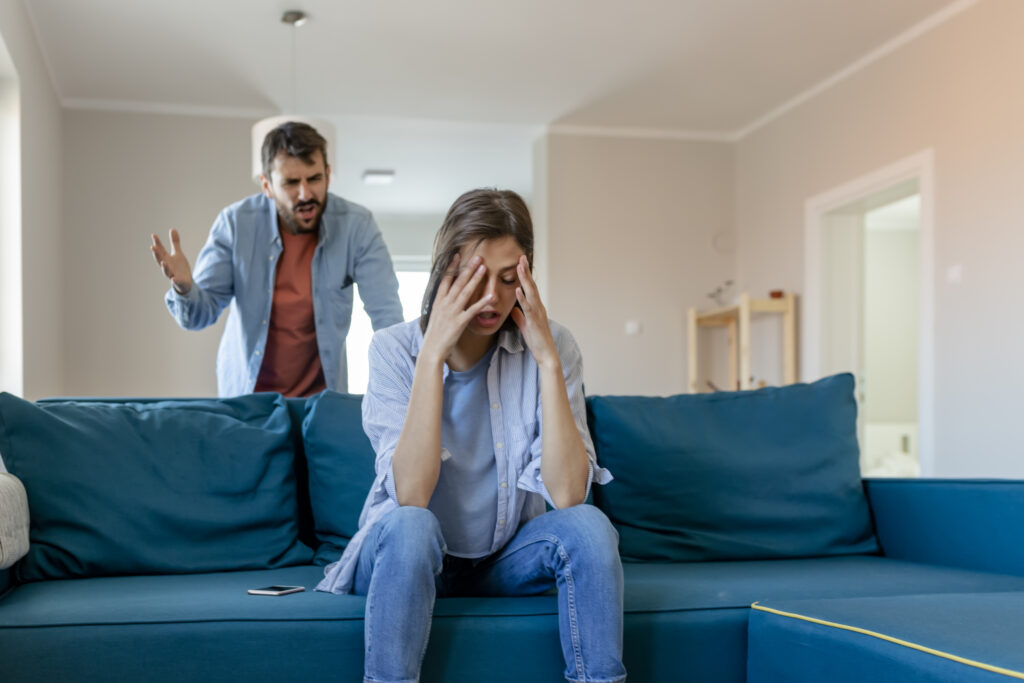
You might find yourself feeling stuck, lonely, and helpless. When your husband yells at you, it can feel scary and alone. The fact you are reading this means you are looking for help and support to make things better, and that is a good sign. You say to yourself, “Why is my husband yelling at me?” And it can feel like the burden of understanding and resolving this inappropriate behavior falls on you and not your husband, causing mental load. Can a husband yell at his wife? This behavior can be problematic as it inadvertently shifts responsibility away from the individual exhibiting the harmful behavior, making it crucial to address the root cause of such actions. Is yelling a red flag? This question is crucial because, from a clinical perspective, yelling can indicate deeper issues in the relationship. While conflicts can occur, consistent yelling is not a healthy form of communication. It’s important to recognize that while understanding the underlying reasons for yelling can be beneficial, addressing such issues often requires professional counseling to ensure both partners’ well-being.
Mental Load
We know from the research that 80% of the time women are the ones to bring up problems in their relationship. Women carry the mental load of family, kids, career and the health of the relationship. In other words…you are not alone.
This is hard and frankly not fair. The reasons run deep….related to social constructs and a patriarchal society. But in this moment that probably doesn’t matter. You just want to be in a relationship of mutual respect, friendship, understanding and connection. So how can you get there?
While it is not “your” problem, if it negatively impacts you, then it is a relationship problem. This means that while you might not be able to fix it, there are actions you can take to improve the situation.
Is yelling normal in a marriage?
Yelling is not a normal or healthy form of communication in a marriage. While disagreements and conflicts are inevitable, how they are handled is what matters. Consistent yelling can indicate a lack of proper conflict resolution skills and can create an atmosphere of fear and resentment. Healthy marriages are built on mutual respect and understanding, where both partners feel safe to express their feelings without fear of being yelled at.
Is yelling a red flag?
Yes, yelling can be a red flag in a relationship. It often signals deeper issues such as unresolved anger, lack of communication skills, or even emotional abuse. When one partner yells, it can create an imbalance of power and control, making the other partner feel disrespected and undervalued. Addressing this behavior early on is crucial to prevent further emotional damage and to work towards a healthier, more respectful way of communicating.
Strategies to address your husband yelling at you
-
-
Self Soothing and Taking Breaks
-
When one of us gets flooded, it is important to take a break since interactions will likely escalate if one partner is experiencing flooding. Once you get back to a regulated state, you are more likely to be able to have a productive conversation.
During the break, you can use self soothing techniques. It is important to not keep thinking about and rehashing the disagreement in your head as that will keep your body in a flooded state.
It is important to tell your husband how you feel when you are yelled at. You can use Dr. John Gottman’s softened start up. This means starting with ‘I feel ______ about _______ and I need______.’
When you start a discussion off with how you feel, it is much more likely to be a conversation that is productive and healthy.
Boundaries are an important tool to use to protect ourselves and to change our own behavior versus trying to change our partner’s. Boundaries are a way of protecting ourselves and setting clear limits about what we will and will not tolerate from someone else.
After a regrettable incident occurs, it is important to process what has happened. There is a Gottman recipe for doing so which takes the guesswork and volatility out of the situation. During the process you both have an opportunity to talk about how you felt and how you perceived the situation.
Understanding why my husband is yelling at me
While this behavior is not ok, it can be helpful to gain some understanding behind why it is happening. Here are some potential reasons:
-
-
Past trauma/attachment wounds
-
-
-
Depression or other mental health issues
-
Seeking professional help
For many couples working through these issues is too hard to do on their own. Seeking help is not a sign of weakness, and a trained therapist can help support you through the process to improve your relationship. They can also be helpful in identifying whether there are individual issues that need to be addressed. You can specifically look for a Gottman trained therapist or use this larger network to find a licensed clinician.
FREE Download | What Are You Really Fighting About?
Download an exercise designed to help you learn how to use conflict to communicate better rather than arguing endlessly.
Sign up for Love Notes and Get the FREE Gottman worksheet, What are You Really Fighting About.