This theory discovered an enormous capacity to destroy human relationships.
Est. reading time: 2 min.
Zeigarnik Effect
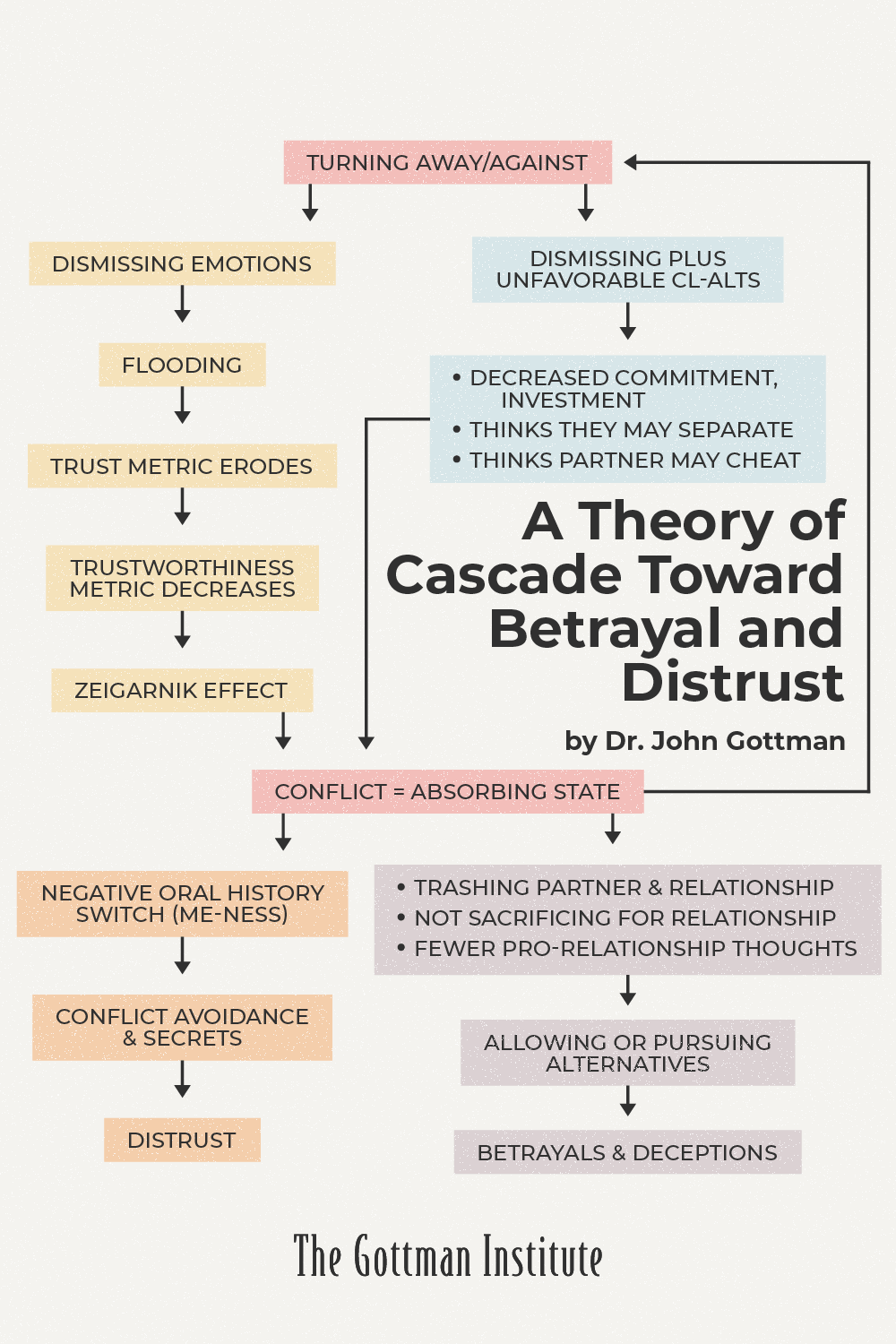
The above diagram, adapted from Dr. John Gottman’s “The Science of Trust” displays his findings on the dynamics of loyalty and betrayal and their deep role in predicting the success or failure of our most intimate relationships. It all begins with a theory discovered in 1922 by a psychology student named Bluma Zeigarnik that has an enormous capacity to destroy human relationships.
Watching waiters in a café in Vienna, Bluma realized something very strange in their behavior: they only seemed to remember the orders that they were in the process of serving. As soon as they had completed their task, the orders disappeared from their memory. What Bluma didn’t realize were the implications of her findings: Ziegarnik Effect.
The Ziegarnik Effect, in simple terms, is the propensity of human beings to remember uncompleted or interrupted tasks better than completed tasks. In the world of trust, Dr. John Gottman found that it translates as follows: unprocessed negative events between partners have an enormously destructive power. Through an ongoing erosion of trust, they gradually and ultimately destroy their most intimate relationships.
Humans have a frustrating and maladaptive tendency towards rumination. According to Dr. John Gottman, “If a couple’s negative events are not fully processed (by attunement to each other), then they are remembered and rehearsed repeatedly, turned over and over in each person’s mind. Trust begins of erode… eventually, one is staying in a relationship, but that relationship is a veritable fountain of negativity (and that) cognitive dissonance is like a stone in one’s shoe.” As this process progresses, one begins to think of their partner with a universally critical eye. With suspicion and mistrust, a partner can be unwittingly vilified.
“It’s no surprise she hasn’t called yet. She never thinks of me…” or “Oh, of course, he’s out drinking again. What a selfish jerk!”
In a spiral, irritation mounts, and feelings of hurt surge upwards. Relationships flare up violently. Couples often stay in mutual volatility. If you find yourself here, check out the Gottman Relationship Coach.
FREE Download | Small Acts of Love Jar
Sign up for Love Notes and Get the FREE Gottman worksheet, Small Acts of Love Jar and learn how to build trust over time with small gestures of love.
Ellie Wilde holds a PhD in Clinical Psychology, and is the founder of Whale Being Therapy, specializing in helping you build stronger, more connected relationships. Drawing on extensive training in trauma and nervous system support, she blends evidence-based somatic practices with creativity, play, and embodied imagination, helping you break free from stuck patterns and rediscover connection, awe, wonder, and joy.
Improve your relationship in 30 days! Backed by over 50 years of research, the 30 Days to a Better Relationship challenge will help you reconnect with your partner and bring more positivity into your relationship. The tools and exercises, delivered once a day for 30 days by email, build on one another and take five minutes or less to complete.